The UAE has transformed into a global sporting destination, anchoring prestigious events like the Abu Dhabi Grand Prix and hosting professional leagues that attract elite international athletes. Accompanying this commercial boom is a highly structured, rapidly modernizing legal ecosystem. For athletes, sports clubs, and agents, understanding the mechanics of UAE sports law is essential to securing employment compliance, navigating commercial partnerships, and mitigating legal risks.
1. The Legislative and Regulatory Framework
The governance of sports in the Emirates relies on a two-tier structure, blending dedicated federal sports laws with national labor guidelines and individual sports federation policies.
Federal Law No. 4 of 2023 Concerning Sports
The structural cornerstone is Federal Law No. 4 of 2023 Concerning Sports. This statute unifies local and federal sports initiatives while formalizing the rights and duties of professional athletes and coaches. It establishes strict licensing benchmarks, mandates corporate governance rules for sports entities, and demands clear provisions for community, competitive, and inclusive sports.
The Interplay with UAE Labor Law
While sports federations maintain autonomy, professional athletes are treated legally as employees. Contracts must consequently interact with Federal Decree-Law No. 33 of 2021 on the Regulation of Labor Relations (further amended by Federal Decree-Law No. 9 of 2024). This standard alignment guarantees mandatory minimums regarding workplace safety, non-payment protection, and fundamental employment rights.
Sector Autonomy
National governing bodies—such as the UAE Football Association (UAEFA)—issue distinct internal rules modeled on international templates like FIFA guidelines.
2. Professional Athlete Contracts
Informal arrangements have been entirely replaced by standardized, fixed-term professional employment agreements designed to enforce commercial and behavioral compliance.
Mandatory Elements of a UAE Player Agreement
- Fixed Duration: Contracts must state explicit start and expiration dates.
- Detailed Remuneration: Base salaries, specific win bonuses, and clear performance incentives must be outlined.
- Athletic Obligations: Contractual mandates require maintaining peak physical condition, attending training, and submitting to medical checks.
- Disciplinary Frameworks: Internal club rules and corresponding financial penalties must be appended.
- Commercial and Image Rights: Rules dictate how a club can leverage a player’s personal brand alongside official sponsors.
The Strict Duality Rule
Per Article 50 of the Federal Law Concerning Sports, designated professional athletes, coaches, and administrators are strictly prohibited from combining professional sports contracts with separate positions in public or private sectors. The law treats sports professionalism as an exclusive, full-time career category.
Regulatory Nuances and Foreign Quotas
National rules place explicit restrictions on squads. For example, the UAE Pro League allows clubs to register an unrestricted volume of foreign players but caps active matchday rosters at five foreign professionals. Furthermore, local regulations guard regional talent pathways; under the UAEFA Regulations on the Status and Transfer of Players, young domestic players turning 18 are heavily incentivized to sign their inaugural professional agreement with their formative parent club.
3. Sports Dispute Resolution
When contractual breaches, wage defaults, or disciplinary rows happen, cases rarely advance straight to standard civil courts. Instead, a specialized, multi-tiered arbitration framework is utilized.
Internal Club Resolution
↓
Federation Committees (e.g., UAEFA DRC)
↓
UAE Sports Arbitration Center (UASAC)
↓
International Bodies (e.g., CAS / Switzerland)
UASAC awards can also be challenged before the Ordinary Courts, but only on a set-aside basis — the merits of the case cannot be reopened.
Institutional Dispute Paths
- Internal Federations: Initial employment or status claims are vetted by domestic dispute bodies, such as the UAEFA Dispute Resolution Chamber.
- The UAE Sports Arbitration Center (UASAC): Established via Federal Law No. 16 of 2016, UASAC serves as the primary specialized sports tribunal in the country. Registered national sports entities must integrate a mandatory clause into their bylaws recognizing UASAC’s exclusive authority over domestic sporting disputes.
- The Court of Arbitration for Sport (CAS): If disputes cross international boundaries (e.g., foreign transfers involving FIFA parameters), stakeholders rely on CAS in Lausanne, Switzerland, as the definitive appellate body.
Enforcement and Legal Binding
A major asset of the local framework is swift enforcement. Under the law, UASAC arbitral awards carry direct executory power similar to traditional civil court judgments. This power is further reinforced by strategic judicial pacts, such as the cooperation agreement between the UAE Sports Arbitration Center and Dubai Courts, which streamlines asset seizures or financial executions against defaulting entities.
Furthermore, sports bodies can levy internal sporting penalties—such as active registration bans or point deductions—against clubs that refuse to satisfy valid awards. While the Dubai Court of Cassation clarified that awards remain subject to narrow judicial oversight via set-aside claims (for severe procedural flaws), the factual and athletic merits of an arbitration award cannot be re-litigated before civil judges.
4. Key Takeaways for Industry Stakeholders
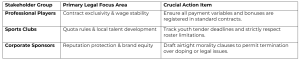
The UAE’s strict insistence on formalized contracting, dedicated arbitration channels, and alignment with global regulatory institutions minimizes operational disruption, providing a secure, balanced playing field for local and international sporting professionals alike.
Whether the question at hand involves a player’s first professional contract, a club’s roster compliance, or a sponsor’s protective clauses, the underlying lesson is consistent: the UAE’s sports law framework rewards those who plan around it in advance, rather than those who turn to it only once a dispute has already arisen.
For further information, please contact HAS Law Firm’s Sports Law team at bd@has.law